Condenser Vs Evaporator – Their working, Maintenacne, Applications, and Difference Table
Condenser:-
A condenser is a heat exchanger used to condense a gaseous substance into a liquid state through cooling.
It is a component of a thermal power plant and is also used in a refrigeration system.
It uses water as a cooling medium.
A condenser is used for taking the latent heat of the fluid and converting it into liquid form.
In this process, the latent heat is released by the substance and transferred to the surrounding environment.
Working of condenser:-
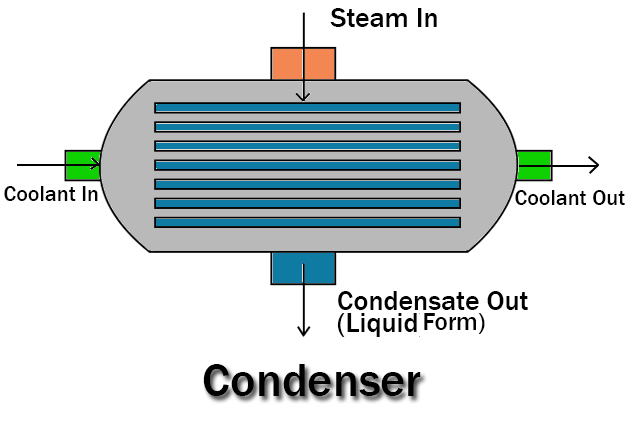
In a condenser, we have a chamber that has water tubes through which water flows.
There are valves in upper and lower sides. The upper side valve is the inlet of vapour, and the lower side valve is the outlet for condensate, which will be in liquid form.
From the left-hand side, coolant will enter the system and flow through the tubes.
When the steam from the inlet comes in contact with the tubes with coolant flowing inside them, the steam will be converted into condensate by giving its latent heat to the cold water.
The coolant will exit the system from the right-hand side.
Evaporator:-
The evaporator is the opposite of the condenser.
An evaporator is a heat exchanger that turns a liquid into a vapour by absorbing heat.
It is a component of a refrigeration system.
It is used to extract heat from the chamber where temperature maintenance is required.
In the evaporator:-
* No work is absorbed or supplied.
* No changes in kinetic or potential energy will take place.
Working of evaporator:-
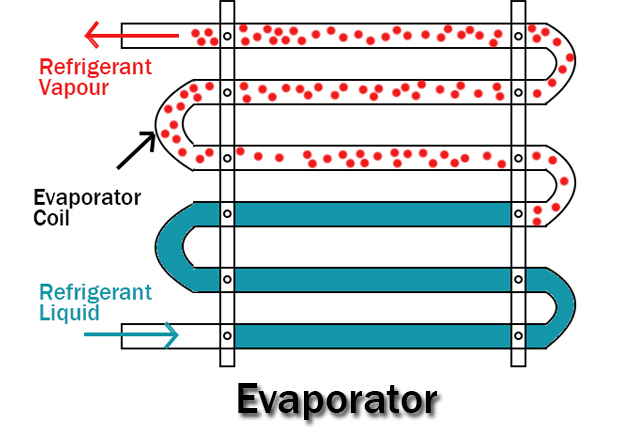
Refrigerating liquid enters the evaporator and absorbs latent heat from the chamber at constant pressure and comes out as a vapour.
The evaporator has a chamber in which the evaporator coil is present.
On the left side, we have the refrigerant liquid inlet pipe, and on the right side, we have the refrigerant vapour outlet pipe.
The refrigerant liquid will enter the evaporator and flow through the evaporator pipes.
In the evaporator pipes, the refrigerant will take latent heat from the chamber and will convert into a vapour, and this vapour will exit from the chamber through the outlet.
Condenser Vs Evaporator – Temperature difference.
The condenser always operates at a higher temperature than the environment because it needs to release heat and condense vapour into liquid. That’s why the air coming from the outdoor unit of the air conditioner is hot.
The evaporator operates at a lower temperature than its surroundings because it needs to absorb heat and turn the liquid into vapour. That’s why we feel cool inside the refrigerator unit, and the air coming out of the air conditioner’s indoor unit feels cold.
Condenser Vs Evaporator – Maintenance Requirement:-
Condenser needs regular cleaning because they are usually outside and hence can collect dirt, leaves, and debris. The buildup can reduce their efficiency, and the AC condenser coil should be kept clean for proper heat release.
Evaporators are placed inside, so only dirt is collected that needs to be cleaned. Evaporators sometimes have ice buildup, which needs to be checked and removed from time to time.
It needs regular cleaning for the prevention of mold growth and ensuring good air flow.
The drain line cleaning is also required in humid conditions to handle condensed water properly.
Common Problems related to Condenser and Evaporator:-
Issues related to the condenser:-
1) Failure of fan motors, which can impact heat release.
2) Leakage of refrigerant that affects cooling efficiency.
3) Bending of fins or metal strips which can restrict airflow.
4) Rust or phsical damage due to exposure to weather elements as it is placed outside.
Issues related to evaporator:-
1) Water leaks due to a clogged drain system.
2) Mould growth occurs in a humid climate if not cleaned properly.
3) Freezing problem because of low airflow or refrigerant issues.
Effects of having a defective condenser and defective evaporator:-
Effects of defective condenser:-
1) A defect in the condenser forces the entire system to work harder.
2) It leads to higher energy bills due to increased energy consumption.
3) The ability to release heat is reduced, which makes the cooling cycle less efficient.
Effects of a defective evaporator:-
1) A defect in the evaporator causes uneven temperature distribution in the space.
2) It reduces cooling efficiency and increases humidity levels.
Applications of Condenser And Evaporator:-
Condensers and Evaporators are used in the following:-
1) They are used in Refrigerators and Air Conditioners.
2) They are used in Power Plants, chemical processing, water distillation, and in some clothes dryers.
Condenser Vs Evaporator – Difference Table:-
| Condenser | Evaporator |
| The condenser releases heat and makes the surroundings hot. | The evaporator absorbs heat and makes the surroundings cold. |
| In the evaporator, refrigerant evaporates from Liquid to gas in the evaporator | In the evaporator, refrigerant evaporates from Liquid to gas in the evaporator. |
| The condenser operates under high pressure and high temperature. | Evaporators operate under low temperature and low pressure. |
| The condenser is placed outdoors in an air conditioner and outside part in refrigerator. | The evaporator is placed indoors in an air conditioner and inside part in refrigerator. |
| Condenser coils are more expensive than evaporator coils. | Evaporator coils are cheaper than condenser coils. |