Difference between Soldering and Brazing- With Steps involved, Advantages, Disadvantages, and Application of both and also a chart table of differences.
Soldering:-
Soldering is the process of joining two similar or dissimilar metals by means of filler material ( lead, tin, alloy ).
The melting point will be less than 450°C of the filler material.
The melting point of filler material is always less than the melting point of the parent metal, whether it is brazing or soldering.
Flux used in soldering is made of resin, zinc chloride and ammonium chloride.
Here are some characteristics of soldering:-
- In soldering, the workpiece is not heated.
- Soldering joints are the weakest among soldering, brazing, and welding joints.
- The cost involved and the skill required are very low or negligible.
- Preheating is not required in soldering.
- Soldering is mainly used in electronic industries to form a permanent joint between electronic components.
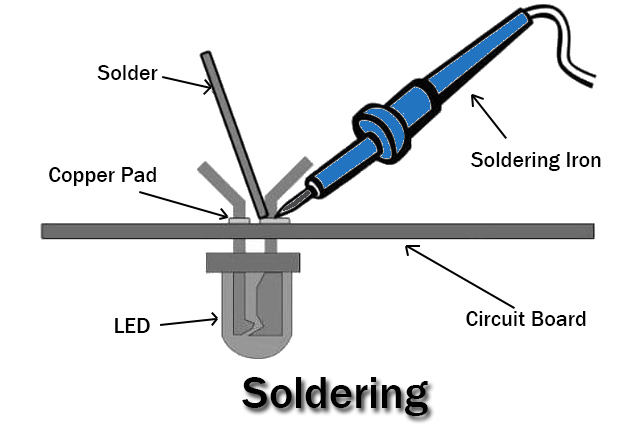
Steps in the soldering process:-
The equipment required for soldering are soldering iron, solder or filler rod, and the workpiece to be soldered. Here are the steps involved in the soldering process:-
1) Before starting the soldering process, it is crucial to clean the workpieces properly so that contaminants like oil, grease, dust, and moisture, or rust can be removed.
If these are not removed, the joint created will be weaker.
Flux, such as borax or resin, is used as a cleaning agent in the soldering process.
2) The soldering iron tip, which is typically made of copper, is cleaned and heated. After that, the solder is applied using resin, which creates a thin film on the iron tip known as ‘tinning’.
3) After that, the iron tip is heated with the solder film on it. The solder film melts, and the molten solder is applied to the joint area. filling any gaps. Subsequently, the joint is allowed to cool slowly. After soldering, cleaning any remaining flux using an appropriate chemical is necessary.
Types of solder used:-
There are different solders for different processes, and different proportions of lead and tin are present in these solders.
Here is a list of different types of solder used:-
Soft solders:- In soft solders, 38% lead and 62% tin are present
Medium solders:- In medium solders, 50% lead and 50% tin are present.
Plumber Solder:- In plumber solders, 70% lead and 30% tin are present.
Electrician Solder:- In electrician solders, 58 % lead and 42% tin are present.
Advantages of soldering:
1) Soldering is operated at a lower temperature than brazing.
2) Most metals and non-metals can be soldered
3) The skill for soldering can be learnt easily.
4) Soft soldering can be undone using a desoldering tool without damaging the base metal.
Disadvantages of soldering:-
1) Joints of soldering are weaker than other metals’ joining processes.
2) Heavy metals aren’t suitable for soldering.
3) Melted solder might leave a toxic flux residue.
4) Improper heating may cause deformities or voids in solders.
5) Higher cost of solder.
Applications of soldering:
Soldering is mainly used in electronic industry where wires are joined, and electronic components are fused to a circuit board.
This technique allows soldering components together with the advantage of desoldering when needed.
Brazing:-
Brazing is the process of joining two similar or dissimilar metals by means of filler material ( Copper Alloy).
Note:- Copper alloy is the mixture of copper, zinc and tin.
A mixture of spelter and borax with water is used as a paste on metal parts.
In brazing, the melting point of the filler material is more than 450°C and may go up to 600°C.
Here are some characteristics of soldering:-
- In brazing, the workpiece is heated but below its melting point.
- The cost involved and the skill required in brazing are much higher when compared to soldering.
- Preheating is beneficial for forming a solid joint.
- Brazing is mainly used to join all kinds of metals used in electronic circuitry, pipe fitting, and automotive.
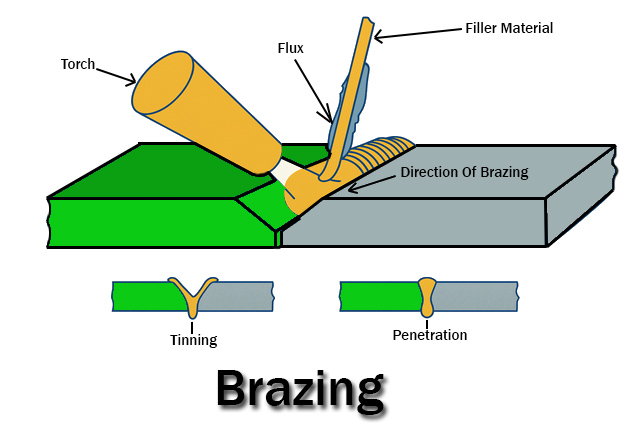
Steps in the brazing process:-
For the brazing process, the equipment needed are brazing torch, filler rod, flux, and gaseous fuel like oxygen and acetylene to create a carburising flame. Here are the stepsinvolved in brazing process:-
1) At first, the surfaceto be joined are cleaned properly, which removes any dust, grease, oil, oxide layer, or foreign substances.
2) Then, flux is applied at the brazing location to prevent oxidation of the base metal and facilitate the smooth flow of the filler material.
3) After that, the filler material is placed on the area to be brazed, and the carburising flame is used to raise the temperature of the filler material above its melting point.
4) As the temperature increases above the melting point of the filler material, it melts and flows into the gap via capillary action.
5) Now, both the filler material and base metal are allowed to cool and solidify and hence a strong joint is achieved.
6) After that, any remaining flux is removed immediately as it has a corrosive property.
Types of brazing:-
1) Torch Brazing:-
In torch brazing, combusted fuel gas is formed by burning acetylene, propane, or hydrogen with oxygen to heat and melt the filler material.
2) Furnace Brazing:-
After applying the paste of spelter, borax and water on metal parts, they are moved slowly through the furnace so that the paste applied melts, and after solidifying, a joint will be created.
3) Electrical Brazing:-
In electrical brazing, heat is generated from the electrical resistance of the brazing alloy, which is perfectly suited for highly conductive metals.
4) Dip Brazing:-
In Dip Brazing, the metal parts are dipped in hot salt after applying the paste, due to which the paste will melt, and a joint will be created.
The brazing joints are always stronger than the soldering joints but are weaker than welding joints because brazing is done at relatively low temperatures.
Advantages of brazing:-
1) Brazing can be used for joining dissimilar metals.
2) Production rates are high in brazing.
3) suitable for metals that may not be weldable due to differences in thickness, e.g., radiators, pipe fittings, containers, and heat exchangers.
Disadvantages of brazing:-
1) cannot joint component operated at high temperature.
2) It requires tight, uniform joint gaps to achieve capillary action.
3) It requires skilled labour to perform when compared to soldering.
4) Brazing joints have relatively lower strength than welding joints.
Applications of brazing:-
Brazing is used in a wide range of industries due to its flexibility and ability to join dissimilar metals.
Here are some applications of brazing:-
1) Fastening pipe fittings, attaching carbide tips to tools, and joining heat exchangers, electrical parts, radiators, and axles.
2) Brazing is used to join metals to wrought, dissimilar metals, and porous metal components.
3) It is also used to assemble bicycle parts like frames and rims.
Chart table of difference between soldering and brazing:-
Here is the table for comparison between the soldering and brazing processes.
Aspect. Soldering. Brazing
| The soldering process is cheaper than metal joining processes like brazing and welding. | Soldering | Brazing |
| 1 | It uses filler alloys with melting temperature below 450 °C. | It uses filler materials with a melting point above 450 °C but below the critical temperature of the workpiece or base metal. |
| 2 | Base metal does not require preheating. | Base metal requires preheating. |
| 3 | It is mainly used in the electronics industry to form a permanent connection between electronic components. | It is mainly used tojoin all typesof metals used in electronic circuitry, pipe fitting, and automotive. |
| 4 | The soldering process is cheaper than metal joining process like brazing and welding. | The brazing process is a bit pricier than soldering. |
| 5 | Soldering creates weaker joints than brazing. | Brazing creates stronger joints than soldering. |
| 6 | Less stable joints can be made. | More stable joints can be made. |
| 7 | Requires less skill. | It uses filler alloys with a melting temperature below 450 °C. |
| 8 | It is used for smaller joints. | It is used for heavier or thicker parts. |