Dual Cycle – Introduction, Derivation Of Thermal Efficiency, Dual Combustion Engine and Applications
Dual Cycle which is also known as mixed or limited-pressure cycle, is a thermodynamic model for internal combustion engines that blend the Otto (spark-ignition) and Diesel (compression-ignition) cycles.
The other names for Dual Cycle include Seiliger Cycle Or Sabathe Cycle.
Dual Cycle was first introduced by an engineer named Gustav Trinkler. In this cycle, part of the heat addition is at constant volume (Isochoric) and at constant pressure (Isobaric).
The name Dual Cycle is derived from the fact that it is an integration of both the Otto and Diesel Cycle.
In this thermodynamic cycle, heat addition occurs partly at constant volume and partly at constant pressure.
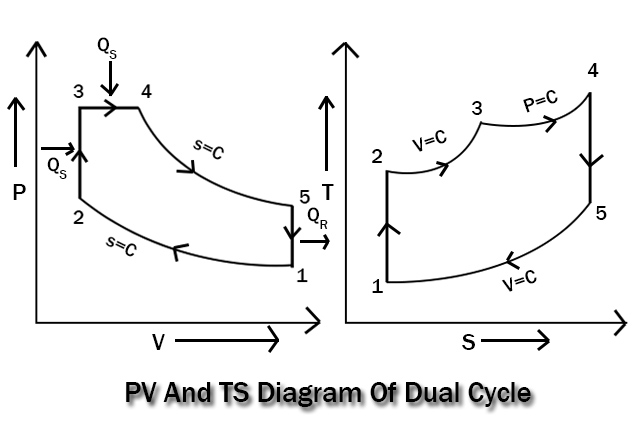
There are 5 steps in dual Cycle:-
i) (1-2) Reversible adiabatic compression
Air is compressed isentropically. In this process pressure and temperature increases from P1,T1 to P2, T2 respectively. Its compression ratio is (V1/V2)
ii) (2-3) Isochoric heat addition
In this process heat addition is carried out at constant volume. In this process pressure and temperature P2,T2 to P3,T3 respectively.
Explosion ratio = P3/P2
iii) (3-4) Isobaric heat addition
In this process heat is added at constant pressure using suitable heating source such that the volume and temperature increases from V3, T3 to V4, T4 respectively.
Cut off ratio = V4/V3
iv) (4-5) Reversible adiabatic expansion
In this process expansion happens adiabatically i.e, no heat is supplied or removed . During this process, the pressure and temperature decreases from P4, T4 to P5, T5 respectively.
Expansion ratio = V5/V4
v) (5-1) Isochoric heat rejection
In this process, heat is rejected at constant volume such that the pressure and temperature decreases from P5,T5 to P1,T1.
Derivation of Thermal Efficiency of Dual Cycle:-
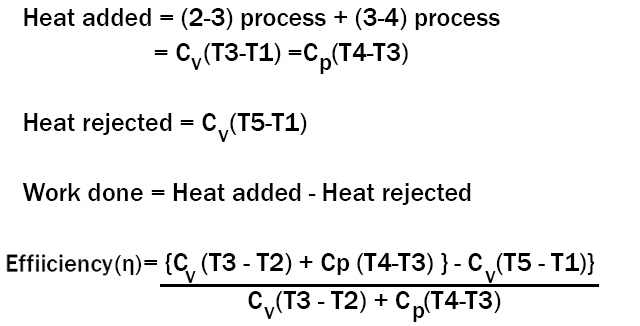
Thermal Efficiency of a Engine is the relationship between the total energy contained in the fuel and amount of energy used to perform useful work.
We know that,
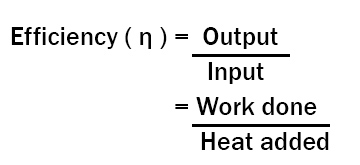
Efficiency ( η ) = Output/Input (It is universal)
= Work done/ Heat added
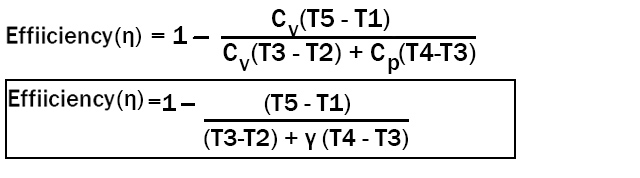
Now, dividing numerator and denominator by Cv, we get:
Dual Combustion Engine:-
Spark is not needed in the Dual Combustion Engine. Dual Cycle is categorized as more modern variation of a Diesel Engine.
Fuel is injected into the combustion chamber much sooner in a dual cycle than in a regularDiesel Cycle because of which fuel starts to ignite late in the compression stroke, part of the combustion happens at constant volume.
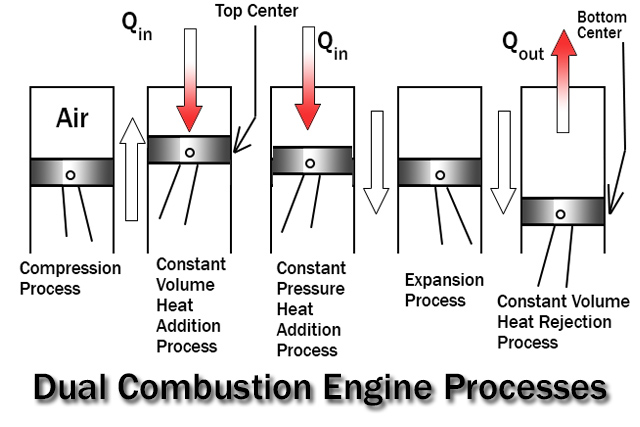
Before the piston reaches TDC (Top Dead Center), fuel starts to come in and for a short period of time, it ignites while the piston is almost still i.e the heat addition process is split into two stages: one that can be assumed to happen at constant volume and one at constant pressure, once the piston starts to move considerably.
The process is almost same as the Diesel Engine and the only difference is heat addition at constant volume.
Characteristics Of Dual Combustion Engine:-
1) It is four stroke engine
2) Improved and modern form of Old Diesel Engine’s cycle.
3) It’s one stroke is divided into two parts allowing it to carry out more work.
4) It has increase efficiency.
Applications Of Dual Cycle:-
1) Dual combustion engines are most commonly used for mobile propulsion in vehicles and portable machinery.
2) In mobile equipment, dual combustion is advantageous since it can provide high power-to-weight ratios.
3) Generally using fossil fuel (mainly petroleum) these engines has appeared in transport in almost all vehicles. ( automobiles, trucks, motorcycles, boats, and wide variety of aircraft and locomotives).