Reverted Gear Train – Introduction, Derivation Of Speed Ratio, Advantages, Disadvantages and Applications
When the axes of the first gear (i.e., first driver ) and last gear (i.e., last driven or follower ) are the same, the gear train is called a reverted gear train.
Reverted gear trains are used in automotive transmissions, lathe back gears, industrial speed reducers, and in clocks ( where the minute and hour hand shafts are co-axial ).
Below is the diagram of reverted gear train:-
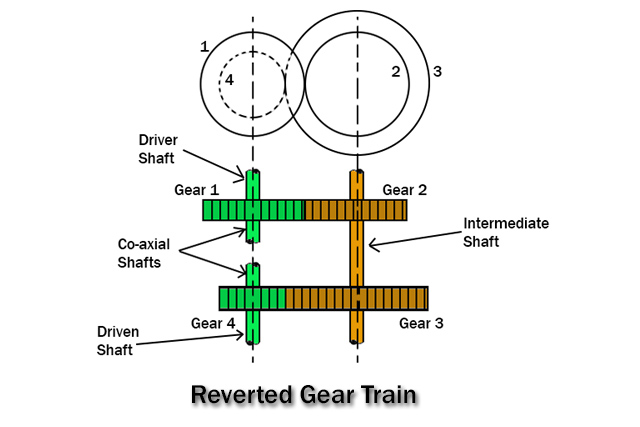
Let there be two gears: Gear 1 (driver gear ) and Gear 4 (driven gear). Both Gear 1 and Gear 4 are in the same axis but not connected directly, and hence it is a reverted gear train.
Now, if the driver gear has to move the driven gear, then we will have to use two compound gears, Gear 2 and Gear 3.
( Note:- Compound Gears means there is more than one gear on one shaft. )
So, Gear 1 will drive Gear 2. As Gear 2 and Gear 3 are compound gears, so Gear 3 will also rotate when Gear 2 rotates.
Now Gear 2 will rotate in the opposite direction of Gear 1, and Gear 3 will rotate inthe same direction as Gear 2. Also, Gear 4 will rotate in the opposite direction of Gear 3.
So, Gear 4 will rotate in the same direction as Gear 1.
Now let,
N1= Speed of Gear 1.
N2 = Speed of Gear 2.
N3 = Speed of Gear 3.
N4= Speed of Gear 4.
Also, let T1, T2, T3, and T4 be the number of teeth in Gear 1,2,3 and 4, respectively.
and, let r1, r2, r3, r4 be the pitch circle radius of Gear 1,2,3 and 4, respectively.
Speed ratio of Gear 1 to Gear 2:-

Speed ratio of Gear 3 to Gear 4:-
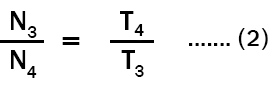
Multiplying (1) and (2), we get
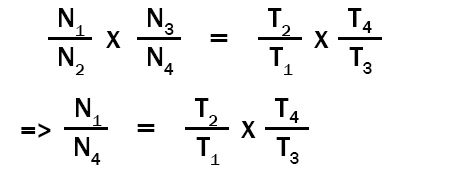
So, the speed ratio of the reverted gear train can be written as;
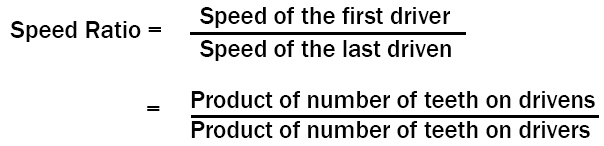
Now, since the centre distance for Gear 1 – Gear 2 and Gear 3– Gear 4 are same, So we can say the sum of the pitch circle radius of Gear 1 – Gear 2 and Gear 3– Gear 4 will be the same. i.e,
r1 + r2 = r3 + r4 …….. (3)
Using the pitch circle radius, we can get the number of teeth. We know that,
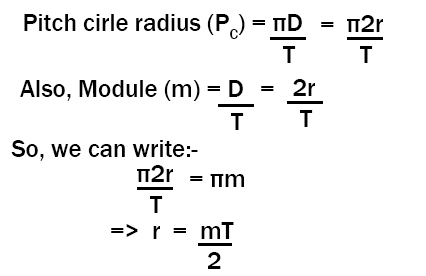
Putting this in equation (3), we get:-

So, this is the relation for the teeth of different gears of reverted gear train.
Advantages Of Reverted Gear Train:-
1) Compact design:- The primary benefit is that it has an input and output shaft aligned, which reduces the physical space needed drastically.
2) High gear ratios:- High gear ratios can be achieved in a limited space using revereted gear train.
3) Reverted gear train offers high power transmission efficiency and smooth operations.
4) Reverted gear train allows the finaloutput gear to rotate in the same direction as that of the input gear, which is useful in certain applications.
Disadvantages Of Reverted Gear Train:-
1) Complexity:- It requires a greater number of gears and shafts, and the centre distances should be precised making its construction a bit complex.
2) Limited speed ratio range:- This gear train cannot be used to achieve very wide speed ratios in a compact space as effectively as the other gear train systems.
3) It is not suited for extremely heavy-duty applications compared to other gear systems.
4) If not engineered properly, the intricate meshing of multiple gears can generate more noise and vibrations.
Applications Of Reverted Gear Train:-
1) Reverted gear trains are used in automotive transmissions. They are ideal for various automotive transmissions where the input and the output gears need to be coaxial, and it allows to achieve desired speed ratios and torque multiplication in a compact design.
2). Used in lathe machines:–
In machines like a lathe, they provide a convenient way to get slower spindle speeds for heavier cuts, with the input and output shaft alligned.
3) Reverted gear trains are used in clocks and watches and are necessary for regulating the precise movements of hour, minute and second hands on a common axis in a compact form.
4) These are used in elevators for precise, smooth control of speed and motion for lifting and lowering.
5) Reverted gear trains are used in industrial gearboxes as speed reducers and other machinery where space is limited and the driven and the driven shaft needs to be aligned.