Sunk Key – Function, Types, Advantages, Disadvantages, and Applications.
Here are the prerequisites to understand sunk key:-
1) Shaft Key:-
A shaft key is a component that is used to connect a pulley or a gear to a shaft. It connects the pulley or gear to the shaft such that when the shaft rotates, the pulley or the gear rotates with it.
There are mainly two types of shaft keys:-
i) Sunk key.
ii) Saddle key.
In this article, we will discuss about sunk key.
2) Keyway:-
The keyway is the groove in which the shaft key fits.
The shaft key is fitted half in the keyway of the shaft and half in the pulley or gear, so that the grip of the shaft key remains on both the shaft and the pulley.
What is a sunk key:-
A sunk key is a type of shaft key in which half of the key fits into the keyway of the pulley, and the remaining half is present in the keyway of the shaft.
Or
The key that fits half in the keyway and half in the hub or Boss is called a sunk key.
Function of the Sunk Key:-
In a sunk key, power is transmitted due to the shear resistance of the key. The relative motion
The shear resistance of the sunk key is also responsible for preventing the relative motion between the shaft and the hub.
These sunk keys are also used in heavy-duty applications, as there is no possibility of the key slipping around the shaft.
The sunk keys are positive drive keys, meaning power transmission is done through teeth or an interlocking mechanism and not transmitted through friction.
In a sunk key, it is necessary to cut keyways both on the hub and the shaft, due to which the sunk key joint is more expensive than the saddle key joint.
Types of sunk key:-
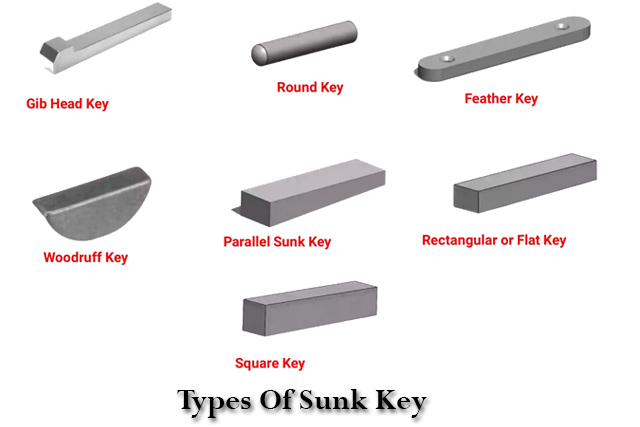
Here is the list of types of sunk key:-
1) Square Key.
2) Rectangular key or Flat Key
3) Circular Key.
5) Parallel Sunk Key.
6) Gib Head Key.
7) Feather key.
8) Woodruff Key.
1) Square Key:-
This is a key that has a square cross-section. These keys are used in general industrial types of machinery.
The square key is used for large shafts. They are usually used for shafts with a diameter of 0.25 to 1.0 inches, but are also available and used for shafts up to 6.5 inches.
Square is not used that much, but mostly a rectangular key or a flat key is used.
2) Rectangular or flat key:-
This is a key that is rectangular in shape from the face side. Rectangular keys are also known as flat keys.
Rectangular keys have more stability than square sunk keys.
Rectangular Keys are convenient for machine tool applications where more connection strength is desirable.
3) Circular Key.:-
Circular keys have a circular cross-section and are placed partly into the hubs and partly into the shafts.
These sunk keys are generally suited for low-power drives.
4) Parallel Sunk Key:-
A parallel sunk key is a rectangular or square key, but without taper.
Parallel keys are mostly used in manufacturing and automotive due to their availability and ease of installation.
Parallel Keys are cheap and easy to install.
5) Gib Head Key:-
This key has a head at one end, so it is called a gib head key. A head is provided to facilitate easy removal of the key.
The gib Head Key is used in a sleeve or muff coupling.
Gib Head Key can be easily applied and removed by holding the head.
6) Feather Key:-
The feather key is fixed in either the shaft, hub, or pulley.
The key transmits power as well as permits axial movement.
Both power transmission as well as permission of axial movement are required in the following:-
1) Clutch
2) Gear Shifting Mechanism
It is a parallel sunk key as it is fitted parallel to the axis of the shaft.
7) Woodruff key:-
The woodruff key is a semi-circular disc of uniform thickness. In this type of sunk key, the upper part is flat, and the lower part is semicircular.
This key can tilt and align itself according to the shaft.
In the Woodruff key-keyway system, the keyway has a similar cross-section as that of the key i.e semi circular disc of uniform thickness.
Functions of the woodruff key:-
1) It is a self-aligning key due to which this key is used in a tapered shaft.
2) As the depth of the woodruff key and keyway increases, the chance of slipping decreases. Due to the extra depth of the keyway in the shaft, it provides more transmitting capacity.
3) It is largely used in machine tools.
Also, it should be noted that extra depth in the keyway in the shaft is also a disadvantage because it will decrease the thickness of the shaft and hence will decrease the strength of the shaft.
Advantages of sunk key:-
1) High Power can be transmitted using a sunk key as compared to other keys.
2) The sunk key has a positive drive; hence, no slip occurs.
Disadvantages of sunk key:-
1) It costs more as the keyway is built into both the shaft and the
Applications of sunk key:-
1) A sunk key is used in machine tool applications.
2) They are also used in general industrial machinery.