Types of Pattern Allowances in Casting
A pattern is a replica of casting, but it has slightly larger dimensions. This change in pattern in casting due to various reasons is known as pattern allowances in casting.
For Example:
When the cast solidifies, it shrink at some extent due to the metal shrinkage property at the time of cooling. So a pattern is made slightly larger to compensate for it. This is an example of pattern allowance. There are many other reasons for pattern allowances, which will be discussed below.
These are the types of pattern allowances:-
i) Shrinkage Allowances:
Shrinkage is defined as reduction is the dimension of the cast during the cooling or solidification process. This is a general property of all materials. The magnitude of shrinkage varies from material to material but every material shrinks.
Shrinkage is of three types:-
a) Liquid Shrinkage
b) Solidification Shrinkage.
c) Solid Shrinkage
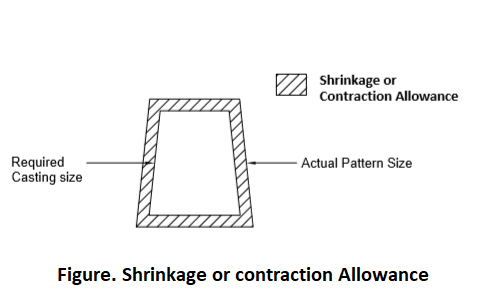
Image Source: https://www.typeandlist.com/shrinkage-allowance.html
The metal shrinkage depends upon the following:-
1) The cast metal pr alloys.
2) Pouring temperature of the metal or alloy.
3) Molding conditions ( i.e. mold materials and mold methods employed )
4) Casting dimensions ( size ).
5) Casting design aspects.
Almost all metal shrinks volumetrically on cooling.
Types of shrinkage:-
1) Liquid Shrinkage:-
It refers to the reduction in temperature when metal cools while being in a liquid state
2) Solidification Shrinkage:-
It is the shrinkage that occurs when the metal changes from a liquid state to a solid state at the solidus temperature.
To account for this shrinkage, a riser, which feeds the liquid metal to the casting, is provided in the mold.
# Aluminium has the highest Solidification Shrinkage i.e 6%
# Grey cast iron has negative Solidification Shrinkage.
3) Solid Shrinkage:-
It refers to the reduction in volume caused when metal loses temperature in the solid state. To account for this, a shrinkage allowance is provided on the patterns.
ii) Draft Allowances:
When the pattern is removed from the mold, the parallel surface to the direction at which the pattern is withdrawn gets damaged slightly and is converted into slightly tapered surfaces.
For compensation of these changes, these parallel surfaces on the pattern are made slightly tapered (nearly 1 -2 degrees). This allows easy removal ofthe pattern from the mold and does not affect the casting in any way. These changes in pattern surface to prevent it from damage are called draft allowances.
The magnitude of taper depends upon:
a) Molding Methods.
b) Mold materials.
c) Shape and size of pattern depth direction in contact with mold cavity.
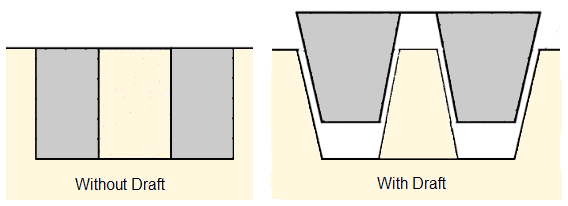
Image Source: https://www.mecholic.com/2017/01/types-of-pattern-allowance-and-its-reason.html
Draft allowance is imparted on internal as well as external surface and it is imparted more on the internal surface than the external surface.
1 to 3 degree taper is given for external surfaces.
5 to 8 degree taper is given for internal surfaces.
# If the pattern is made by wax, mercury and polystyrene, then no draft allowance is required.
iii) Machining allowances:
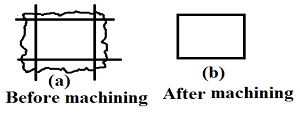
As we know, the product of a casting process gives very poor surface finish, hence the surface of final product of casting will be rough. But we need a product which is polished and have good surface finish.
So to obtain good surface finish, the final product of casting is machined with the processes like turning or grinding to improve the surface finish.
This machining after the casting process causes a significant loss of mrtal from the mold part. To compensate this loss, machining or finishing allowances are given in the pattern of casting. This allowance is added together with basic size of pattern. It ranges from lower than 2 mm to 15 mm based on size and material of the part.
The amount of allowance added to the pattern is based on,
a) Material used
b) Machining processes used
c) Requirement of accuracy.
d) Molding methods used.
e) Shape and size of casting.
iv) Shake or rapping allowances:
When the pattern is to be removed from the sand of casting , the pattern will have to be shaken slightly to remove it from the sand and this will cause a slight increase in dimension of casting.
To compensate this increase in dimension of casting, the patterns are made slightly smaller from casting. This change in dimension of pattern is known as shaking or rapping allowances.
Shake allowances are normally provided to large castings because it is negligible in the case of small castings and are thus ignored.
The magnitude of the shake allowance can be reduced by increasing the taper.
v) Distortion or camber allowances:
When the metal is in cooling process, stress is developed in the solid metal due to uneven metal thickness in the casting process. This stress may cause distortion or bending in the casting.
Other reasons for the distortion of metal are :-
1) Irregular shape of metal
2) It is U or V-shaped.
3) It has long, rangy arms like those of a propeller shut for the ship
4) It is a long, flat casting.
5) The arms possess unequal thickness.
6) One portion of the casting cools at a faster rate than others.
7) all its parts do not shrink uniformly,
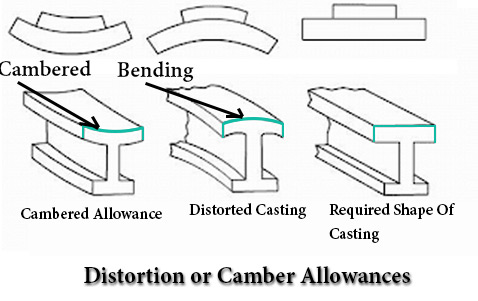
To avoid this bending or distortion in casting, camber is provided in the opposite direction so that when bending occurs due to uneven thickness of metal, the casting becomes straight. This change in pattern shape to compensate for bending while casting is known as Bending Allowances.
The amount of distortion allowances may vary from 2 to 22mm depending upon the size, shape, and material of the casting